I know that one of life’s great fantasies for many people is to open up a small, personal restaurant in a beautiful spot: to serve great food and wine to your friends and grateful strangers who are amazed by your talent for food and hospitality. For reasons that I have never entirely understood, lawyers, doctors, and entrepreneurs seem to be especially vulnerable to this fantasy. Some have even acted on it. Part of the reason that I have been writing this all down is in the hope that this will introduce a little bit of reality into the mix, and maybe stop a few otherwise very competent professionals from making a very expensive mistake. If you open a restaurant, it should be because you have no other choice. It must be because you have to cook, to create great food, to discover great wines and share them. because you believe, probably against your better judgement, that you can change people’s lives with your food and hospitality. You have to be able to welcome all kinds of people into your life, even cranky people who don’t understand the first thing about your vision. You have to commit all of your time, your energy, weekends and holidays, and sacrifice most of your freedom in order to maintain this vision.
After selling About Thyme Cafe, Richard and I wanted nothing more than to work for someone else, collect a regular paycheck-preferably with benefits and little or no responsibility- and spend time with our baby. Of course, good benefits often come with responsibility, so Richard took a job at a major ski resort and spa in Stowe as dining room manager for their main restaurant. I took a nice, responsibility-free job as a pastry chef for two high-end Stowe resort restaurants owned by the same company. Unfortunately, the commute was long and our hours were such that we rarely saw each other. We got into a pattern we called the Baby Relay: I got up at 4:45 AM, drove to Stowe, and worked a nine-hour shift while Richard took care of Ariel. At 3 PM I met Richard and Ariel in a parking lot halfway up the mountain; we’d hand off the baby, have a quick kiss -if we were not too stressed- then he’d be off to work until midnight. I took Ariel home, fed her and played with her, and then we both fell into bed. It worked: we had no child care costs. We had regular paychecks, benefits, and vacation time. We also had a marriage conducted largely in a parking lot halfway up a mountain in Stowe.
When the resort hired a new food and beverage manager, Richard became miserable almost overnight. The new guy was a bully who instantly disliked Richard. He must have stayed up late at night thinking up new ways of making Richard’s life hell. He was very good at it. He couldn’t fire Richard, so he eventually removed him from his manager’s position and salary and put him on as sommelier, with a small base salary and commission on wine sales. It turned out to be the best thing that could have happened.
Richard was always interested in wine. At About Thyme he’d taken great pride in searching out wonderful, little-known wines at exceptional value for our dinners. He had begun to develop a reputation as a go-to wine guy in Montpelier. In Stowe, he developed that talent further. He met with wine representatives and distributors, learned how the system worked, tasted wines constantly and sharpened his palate. To the food-and-beverage manager’s surprise, Richard began making considerably more money than he had been making as a manager through his charm and gift for upselling wine to the eager clientele.
Eventually we began to realize that we both hated this schedule. The thought occurred to us that what we really hated was allowing ourselves to be “managed” and controlled by others. We were coming to the understanding that we would never be the kind of people who could work for someone else. I wanted to cook my own food again. I missed the warm feelings and positive reinforcement of serving my own creations in my own place to people who were changed by the experience. Richard hated being at someone else’s mercy, working for people who don’t have his instinct for hospitality. We began to search for something of our own.
Living in the small cabin that I bought when I first moved to Vermont was becoming more and more difficult as Ariel grew. We decided to look for a place that we could live in and convert to a restaurant. The hour-long commute to Stowe was horrible. There was nothing so attractive as the thought of living upstairs and stumbling down in the morning to work in pajamas. Vermont was full of gorgeous nineteenth-century farmhouses that would make fabulous small country restaurants. The trick was finding one we could afford in a place that would be a good business and life decision. There was the issue of finding a school for Ariel. There was also the issue of permits and zoning that would allow us to convert a home and run it as a restaurant in a residential area. Restaurants are famous for the difficulty of getting permits. You need water, sewage, parking, venting, and fire safety, a liquor license, and neighbors who want you there. We drove hundreds of miles on our infrequent days off looking at properties. We saw quite a few beautiful houses that we loved the look of, but there were logistical problems with each one. We put in an offer on one gorgeous brick Federal-style farmhouse, but lost it to a better offer. The heartbreak lasted for weeks. Eventually, my belief in fate and good karma was rewarded.
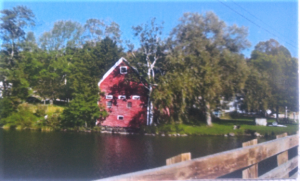
One of our most regular customers at The About Thyme Cafe was Ed Koren. Ed was a New Yorker cartoonist, famous for his wonderful whimsical drawings of shaggy creatures and shaggy people. He had a razor sharp wit and a deep and abiding love for his life in rural Vermont. Ed and his wife Curtis and son Ben lived 16 miles from Montpelier in Brookfield, VT. Brookfield is a tiny hamlet, with a population of about 1,200 men, women, and children. Of course, there are considerably more cows, chickens, and goats. Brookfield sprawls over hills and valleys, with a small group of charming homes gathered around a tiny lake. This is Pond Village. It’s the home of the only floating bridge east of the Mississippi, so for years it’s been a tourist destination, especially during fall foliage season. There was a bed and breakfast – The Green Trails Inn – that had been there for well over a hundred years, although not at first as an Inn. Green Trails Inn began in1932. It was founded by Jessie Fiske as a small summer riding camp in Pond Village Fiske invited four college students—each named Mary—to spend a month riding horses at her Brookfield home; the group became known as the “Four Marys.” Eventually, Jessie Fiske bought several buildings surrounding the original, including an old Pitchfork factory that became known as The Fork Shop. The Fork Shop had been opened as a tea room starting in the early twentieth century. It became a restaurant, which was closed for the final time in 1986.
Other than that, in Pond Village, and actually in the surrounding areas of Brookfield as well, there are only family homes and farms, a town hall built in 1856, and the oldest continually operating library in the U.S. housed in a tiny room attached to the town offices. The elementary school, just 3 miles away, had a reputation as one of the best in the state: tiny, with small classes, excellent teachers, and a deep commitment to its students’ educational and emotional growth.
Ed loved the About Thyme Cafe and had been trying for years to convince us to open a restaurant in Brookfield. Since the Fork Shop had closed, there was no place for Brookfield residents to meet for a drink, a meal, and a conversation outside of their homes.
As we drove into Pond Village, I fell immediately in love. From that moment, I could not be persuaded that our restaurant would open anywhere other than this magical place. The fact that any customer approaching Brookfield from the north would have to travel five miles down a dirt road, or drive a long stretch of highway from the south, didn’t deter me. I have always wanted to live on or near water, and here was a beautiful lake, with clear, clean water for swimming, fishing, and kayaking. The 1840s-era farmhouses looked exactly like the home I had always envisioned for myself. We looked at the Fork Shop building. We loved it, but the crotchety owner really didn’t want to sell. We looked at another building, but the price was too high. As we drove around Vermont in the next few months, Richard tried to get me to consider other towns, but my mind was made up. We would make a restaurant in Brookfield or not at all. Then fate intervened once again. We got a call from a couple who were ready to move. They had a large house with a historic red barn on the water, just across from the inn, next to the floating bridge. They wanted to move to somewhere smaller, further out in the country, away from the bustle of the tiny village. They knew we were looking and invited us to come look at the house and talk to them.
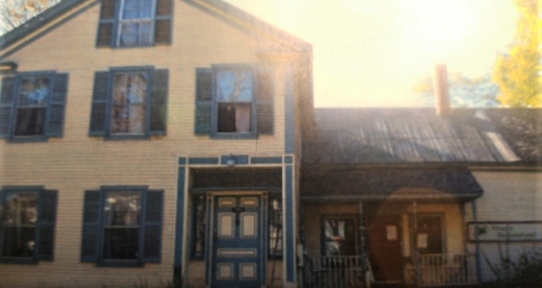
Six months later, we had sold our cabin, and were living with friends while permits, parking variances, and other zoning issues were worked out. We waited out a last-minute case of cold feet by the sellers, signed the paperwork for the mortgage and business loan, and moved into our new home and restaurant-to-be. These days, the financing for a home-restaurant would be almost impossible. Banks are well aware of the failure rates in the restaurant business. We were still young-ish, in our thirties, with a baby and almost no money in the bank. But we had run a successful cafe and had paid back the bank loan for that business early. It was 1996, and money was a bit easier to come by if you had a good track record. We also had a few angels. They were people who believed in us and were willing to give us small loans and to vouch for us with the bank. And of course we had my parents, who have trusted us way beyond what good sense should have allowed, and have helped us with every business we started. We will be forever grateful to these amazing humans.
Those were the hardest months of our lives up until then, although we have been through some very difficult times since. We wanted this house so much; we knew it had to be ours, but there were so many problems. We had meeting after meeting with the state about building a new septic system. The neighbors were wonderful. They wanted us there so badly. The current owners of the Green Trails Inn agreed to host our leach field on their property. The next-door neighbors agreed to let our guests park in front of their houses so the idyllic aura of the village would not be disrupted by a parking lot. Richard had to keep his job during the process of buying the house and building out the restaurant, as we desperately needed the money. No one at his work could know about what we were doing or he might have been laid off or fired. He went to work exhausted every day. I had injured my back and could not work, so I directed construction and took care of Ariel from a prone position on the living room couch. Huge amounts of pharmaceuticals and lots of physical therapy were not enough to heal my back. We were terrified that after all this I would not be able to stand in my kitchen for 16 hours a day in time for our projected opening. A small surgical procedure at Dartmouth Hitchcock Hospital made a huge difference, and eventually I was up and ready to work.
It took another year or so to get the restaurant ready to open. The entire first floor of the house had to be reconstructed. A commercial kitchen was designed and built. A large storage shed attached to the main building received a beautiful hardwood floor, a handmade hardwood bar and a ceiling constructed from beams found in a nearby barn to become a warm and inviting bar area. A two-hole privy attached to the bar area was converted to become our walk-in refrigerator. The dining rooms were painted, and we hired Mindy, a well known local artist, to create a gorgeous mural of flowers and fruits around the picture window. There was menu development to work on. We had to find suppliers and develop ordering procedures, hire kitchen help and waitstaff, and obtain health department and fire safety permits. We applied for a liquor license and a license to play recorded music in the restaurant. We needed to buy insurance, arrange for linens and laundry, and add a massive and expensive ventilation and fire suppression system in the kitchen. We traveled to lower Manhattan several times to buy fabric for tablecloths and windows, plus plates and glassware, silverware, and pots and pans. We attended auctions for used kitchen equipment and drove to Massachusetts for the pieces we had to buy new.
Creating and permitting the water and sewage systems required for us to seat 40 guests was more difficult. We had a lot of help from some of the state and county representatives, all of whom wanted to see us succeed. They gave many hours of their time to helping us find ways to comply with the regulations in our area. We went through septic hell, finally putting in an experimental system that caused our backyard to be completely dug up and refilled with sand, making our back lawn spotty and pathetic for years to come. After a meeting of the residents in the town hall we were granted permission from the town to dig a well in the town park, the only spot far enough away from our septic system to be permissible. For two days we sweated bullets while the well company dug down, down, finally hitting plenty of water at a depth of over 500 feet. I would have given up long before that, but Richard is stubborn and kept saying “just 20 more feet” until, finally, at 500 feet, he said “just 5 more feet,” and an appropriate amount of water was achieved.
It was just about two years between finding the house and opening the restaurant. Two years of exhaustion, stress, fear and dread, not insignificant physical pain and moments of overwhelming joy. We had designed every aspect of the restaurant from the paint colors to the sign, from the menu to the wine list, from the dining rooms to the flower beds. That was the fun part, and it was so much fun! The not-so-much-fun part: we were in debt to the bank, and my wonderful parents, and we had no financial cushion. We jumped in with both feet, setting up a pattern that we would follow for good and for not-so-good for the rest of our business lives.
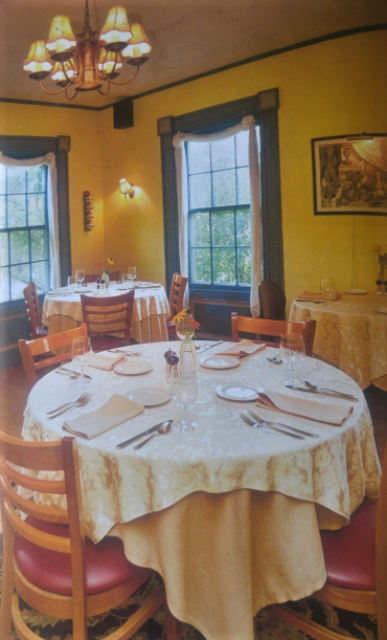
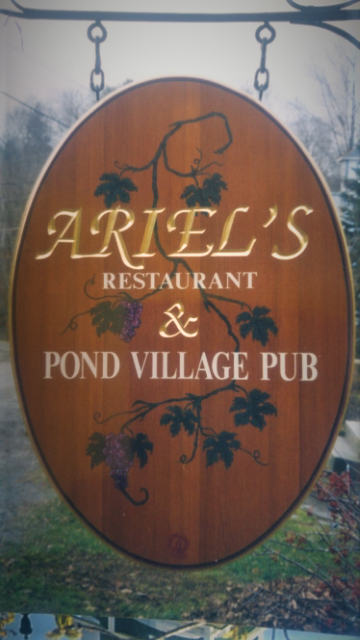
We named our restaurant Ariel’s Restaurant and the Pond Village Pub. Since then, Richard and I, and eventually our two children, Ariel and our son Noah, who arrived two years after we opened Ariel’s Restaurant, have lived the lives of a restaurant family. It’s not necessarily a normal life, but it has amazing rewards built in, as well as an exhausting, punishing schedule. Owning and operating restaurants is all about risk. We’ve taken many risks. Some have panned out beautifully. Others, well, it’s hard to decide whether the risks were worth it. We certainly learned a lot. Life has been full and rich (not so much in the monetary sense). The stress and anxiety are almost always there, but so is the sense of accomplishment and the reward of doing what you love and having so many people appreciate it.