In 1987 I decided I really missed New England, and I would do my damnedest to get back up there. Through an ad in a culinary magazine I found out about a restaurant manager job at the New England Culinary Institute in Montpelier, Vermont. I applied, they flew me up for an interview, then flew me up again for a cooking test. They eventually hired me as a chef-instructor for the second year class in Catering. That’s where I first met Richard.
Family legend has it that we loathed each other on first sight, although Richard tells me that it was not the case. He swears that it was only me who loathed him. Richard had moved to Vermont two years before to live on a piece of land owned by his parents to try to rebuild the small house on the property that had been allowed to fall into disrepair. He was working at the Institute’s fine dining restaurant as a bartender/waiter. I was angry, exhausted, bedraggled, forced into making and delivering tidbits for the restaurant’s bar. This at the end of a 10-hour day trying to teach green kids how to cater high-end weddings. The first time I saw Richard, I stumbled into the bar, slammed a tray of hors d’ouevres down on a table and snarled, “here, dammit. Hope they choke someone who deserves it!” Richard, drying glasses at the bar, smiled goofily and said, “And good afternoon to you, too.” I assumed that he was an ass; he decided that I was nasty, but intriguing.
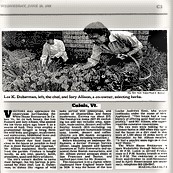
After a year I left the school to be the executive chef at The White House Restaurant, a gorgeous small farmhouse restaurant run by two very elegant gentlemen: Leo Romero, owner of Casa Romero in Back Bay, Boston, and his interior designer partner, Iory Alison. I loved the freedom I was given to create an entirely new menu whenever I wanted to. I was encouraged to use the produce from their extensive gardens and work with local farmers-a nearly unheard of thing in the 1980s. I was able to serve quirky, imaginative food for up to 50 people per night at the exorbitant price of $27.00 for a three- course-fixed-price-dinner. It was my first experience at a high-end farm-to-table restaurant as executive chef, and it couldn’t have been a better start to the kind of career that I wanted to have.
One night I was shocked to see Richard walk into the service entrance. He was trailing after Lana, a longtime waitress at the White House. I had no idea that she just happened to be Richard’s ex- girlfriend. Richard took a job as a waiter there, and we started warily circling each other. At some point we started realizing how much we had in common. During service we rarely saw each other. He worked upstairs in the formal dining room. I was in “the dungeon”, an underground kitchen that was humid as hell in the summer. Condensation dripped down the walls and sweat flowed off the cooks’ faces. The kitchen was bone-shatteringly cold at the end of our season in November, after the leaves fell and the “leaf peepers” departed the state. Lana (conveniently) took off for other parts, and shortly after that Richard asked the question that shaped our lives for the next oh so many years. He had been popping down to the dungeon between customers and peering over my shoulder at the plates that I was composing. I have to assume he was impressed with my cooking, as he asked me to open a restaurant with him long before he asked me for a date. That came a bit later, after, I’ll admit, more than a little obvious hinting on my part. When the season ended, Richard moved with me into the little cabin on Bliss Pond that I had purchased the previous fall. We have not been apart for more than two weeks at a time since then. Two kids and four restaurants later and we’re still together. Go figure.
The About Thyme Cafe (1989-1994)
A year later we left the White House to open our first place. We named it About Thyme Cafe. At this point I don’t remember how or why that name even occurred to us. We had been talking for a while about the style of food service establishment that we wanted to open. We lived within a short drive of Montpelier, the capital of Vermont, and we felt it was ripe for a kind of community cafe. There are many of these around the central Vermont area now, but in 1989 they were few and far between. There was only one place that you could find a cappuccino machine in Montpelier. As we were both passionate about good coffee, that was a major part of our plan. We found a space on one of Montpelier’s two major streets just a few blocks from the statehouse. It had already been a sandwich shop so the permits for a restaurant were easy to get.
Our friend Mick from our monthly poker group was a carpenter, and another close friend, Cameron, a former chef, was a terrific cabinetmaker. They quickly made that place into a charming little (very little) cafe, with a black-and-white tile floor and a picture window on the street. Richard and I, in what has become a pattern for all of our restaurants, shopped in funky barns, used furniture stores, and old churches. We attended auctions where other restaurateurs’ misfortune became our good luck. We picked up hanging lights from an old theater. We found a huge, salmon-pink refrigerated display case from a nearby shop that had recently closed. That display case became the focal point of the cafe, along with the elaborate and massive Italian copper espresso machine that we found in a barn full of old treasures, and which took up almost the entire back counter.
From the beginning, business sense took a back seat to an unshakeable desire to do things the best possible way. This almost always meant the hardest possible way. In a tiny space with a kitchen seven feet wide by twenty feet long I made everything from scratch. We baked our own breakfast pastries, made five kinds of bread for sandwiches, corned our own beef, roasted our turkey breasts, made mayonnaise and olive relish for our Muffalettas.
At that time Montpelier was known as a hangout for back-to-the-land types, mostly due to the nearby presence of Goddard College. There were plenty of cooks who had been trained by the local health food restaurant and who knew everything about how to make whole grain breads and creatively use tofu, Indian spices and seasonal produce. I’m not putting this down. The Horn of the Moon Cafe was an inspirational and pioneering restaurant in the 1970s style. It emphasized organic produce and vegetable-forward cooking and its influence is still felt in Vermont and throughout New England. Except for the New England Culinary Institute students there were few who knew anything about European- style pastries and perfectly pulled espressos. We trained our young staff from scratch to work the espresso machine, although no one ever quite met Richard’s exacting standards. I did all of the recipe research and development myself, and I was lucky enough to find a few fabulous women who were eager to learn my style of cooking. Pat, Margaret and Annie turned out to be talented and intuitive cooks, and became some of my best friends. I worked with them on and off for more than twenty years.
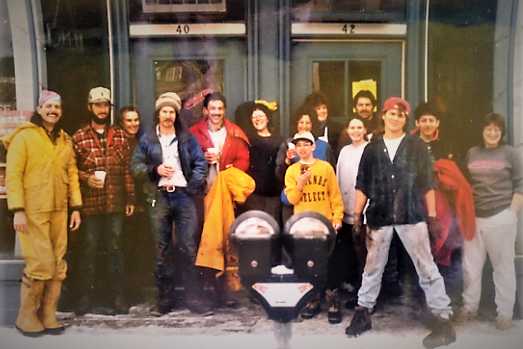
With our young and enthusiastic staff we catered weddings, tree farm anniversaries, three day yoga retreats. Campers from nearby “Rainbow Family of Living Light” gatherings used our restrooms to bathe and change their clothing, no matter how nicely we asked them not to do so. Montpelier is the smallest capital in the US. Everyone in Montpelier pretty much knows everyone else, both in government and in local business. The About Thyme Cafe was located almost directly across from the Statehouse, so we sent many breakfasts and lunches to the offices and meeting rooms of government officials, including the governors – first Madeleine Kunin, then Howard Dean. We catered dinners for Senator Patrick Leahy and many other Vermont politicians. After a few years of breakfasts and lunches we started doing weekend dinners, giving me a chance to create new menus weekly. We used local produce from nearby farms in the early 1990’s, when very few were even contemplating doing such a thing. We charged $3.75 for our house made corned beef sandwich on house made Jewish Rye, and while people did complain about the price they lined up outside the store to buy them.
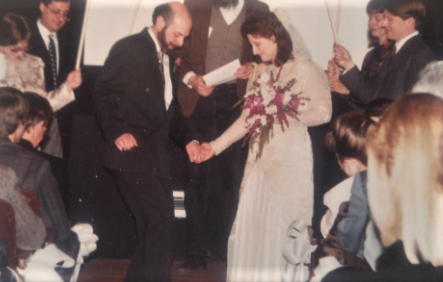
We worked fourteen hours most days but had our nights mostly free. Richard and I finally accepted the inevitable and got married in February of1991. By that time our staff was able to run the place without us for two weeks while we went on a honeymoon, our first time off in years. Hitchhiking around Belize we watched the first Gulf war on black-and-white portable television sets in funky dive bars on Cay Caulker. We rode horses in the rainforest and a motorbike alongside the beaches.
We decided to rent a truck and drive into Guatemala to try to see the ruins at Tikal. Shortly after we crossed the border we realized that we were in way over our heads. We had done no research, so didn’t realize that Guatemala was in the throes of a decades- long civil war. The roads had been bombed out They were full of massive holes and deep ruts and were basically impassable, especially with the almost completely useless old vehicle that we had been given by the “rental agency” on the border in Belize. I was starting to get hysterical and kept asking if we shouldn’t turn back, especially when we passed a compound on the side of the road. The rise from the road to the compound was lined with human skulls, and there were young men wearing ammunition belts over their bare chests looking at us from the top. We had decided to turn back soon after when the truck made a horrible noise and ground to a stop. It was then we encountered the kind of luck and human kindness that seems to have followed us throughout our lives. A young woman appeared from out of nowhere, and asked what had happened. At that point our Spanish was nonexistent but she had a little bit of English. We explained, and she said that her village was just up ahead and her brother was a mechanic. We should come with her and she would send her brother to look at the truck. We followed her to a very small, very rustic village of perhaps a hundred people on the bank of a small river. She took us up to her family’s apartment above a small tienda and gave us eggs, black beans and tortillas. That was one of the best meals of our lives! All of the love and kindness we were experiencing was in the food. After we ate she and her mother took us to the river to wash up. The brother came back and told us he had fixed the truck but it was far too dangerous for us to leave that evening and drive back in the dark. He didn’t have to work hard to convince us to stay over. After a generous breakfast the next day the family walked us back to the truck and gave us a big burlap sack full of hand- made dolls, wooden whistles, and traditional Christmas ornaments. I’ve never felt so grateful and cared for. The whole incident actually made us want to travel more into unknown places, and meet more of these amazing people. And we have done just that.
We were a little nervous about what we would find in the cafe when we returned. When we got back, we found that Margaret and the other nutcases who worked for us had decorated the outsides of the coolers and the walls of the cafe with slices of luncheon meat and processed cheese to welcome us. Other than that, the business seemed to be intact.
Unfortunately, shortly after we got back up and running, the economy started to nosedive and business became somewhat less consistent. In March of 1992 a massive flood caused by an ice jam on the Winooski River shut down the main business district of Montpelier. Up to seven feet of water rose in the streets. Our little store was mostly destroyed, along with all of the other businesses along Main and State streets. Our storage in a basement next door was completely underwater. We lost almost everything. The next day the temperature dropped and the remaining floodwaters froze. Over the next few days our wonderful friends and loyal customers helped us clean up, haul out, and throw away much of what we owned. Very few businesses in Montpelier had qualified for flood insurance. FEMA did a wonderful job of getting money to those of us who could not rebuild without it. Three days after the flood, we were open and serving pastries and coffee to the cleanup workers. Within a week we were fully in business again.
Between the economy and the flood, our business never really recovered its former vitality. In 1993, I gave birth to a baby, Ariel. I was two weeks late when I went into labor at midnight. That day we had catered a Bar Mitzvah for over one hundred people, and I worked from about nine in the morning until ten at night. We knew this was definitely going to be a baby who was comfortable in the restaurant business. For the first nine months of Ariel’s life, we brought her to the cafe at 6 a.m. every day and set her on a worktable in the kitchen in a little basket. As Ariel got bigger, we would pass her out to our regular customers. They would hold and play with her while we got through the breakfast and lunch hours. Occasionally Richard would put Ariel in a baby carrier on his back, and by the time she was eight months old she had learned to open the drawer on the cash register. We weren’t sure whether that was a good thing or not.
In March of 1994, five years after opening, we sold the About Thyme Cafe. We were exhausted, the bills kept coming and just keeping up with them required more work than we could do with a nine-month-old baby.
Today, more than 30 years after closing the cafe, we still have people stopping us on the street to ask for recipes. Some of the food we made was an everyday part of people’s lives. They still crave our Cranberry Cream Cheese Buttermilk Biscuits. Roasted Root Vegetables went home with so many people for dinner that we had to make them fresh sometimes twice a day. Our brownies, lemon bars and chocolate chip cookies were standard at every state government meeting. My two years in New Orleans showed up in the gumbo, muffaletta sandwiches and the red beans and rice served on Mondays, as is traditional in New Orleans.
This recipe followed me from The About Thyme Cafe to every other restaurant we owned. I’ve served it at many dinner parties and pot lucks, and it is probably my most requested recipe ever. You’re welcome!
Moroccan-Style Chicken with Apricots and Almonds
Serves 6 generously
Ingredients
For the Chicken and Marinade
- 2 tablespoons extra-virgin olive oil (27 g)
- 1 tablespoon finely chopped garlic (about 9 g; 3 large cloves)
- 1 tablespoon ground coriander (about 6 g)
- 1½ teaspoons ground cinnamon (about 4 g)
- ¼ cup honey (85 g)
- ¼ cup pomegranate molasses (about 80 g)
- 8 boneless, skinless chicken thighs (about 1.4–1.6 kg / 3–3½ lb)
- 1 teaspoon kosher salt (about 5 g), plus more as needed
For the Apricot Sauce
- 4 cups chicken stock (960 g or ml)
- the remaining spice, honey and molasses marinade
- 2 medium carrots, peeled and thinly sliced (about 200 g)
- ½ cup chopped dried apricots (about 70 g)
- 1 tablespoon cornstarch (8 g)
- ¼ cup cold water (60 g or ml)
- Kosher salt and freshly ground black pepper, to taste
To Finish
- ¼ cup chopped toasted almonds (about 30 g)
- Mediterranean Couscous Pilaf, for serving
Method
- Make the spiced marinade.
In a 2-quart saucepan, heat the olive oil over medium heat. Add the garlic, coriander, and cinnamon. Cook, stirring constantly, for 1 minute, until fragrant; do not let the garlic brown. - Add the honey and pomegranate molasses. Bring the mixture just to a gentle bubble, then remove the pan from the heat.
- Transfer half of the warm spice mixture to a small bowl and let it cool completely. Leave the remaining half in the saucepan; it will become the base of the sauce.
- Marinate the chicken.
Place the chicken thighs in a nonreactive bowl, baking dish, or resealable bag. Add the cooled marinade in the bowl and the salt, then turn the chicken until evenly coated. Cover and refrigerate for at least 2 hours or, preferably, overnight. - Make the sauce.
Add the chicken stock to the reserved spice mixture in the saucepan. Bring to a boil, lower the heat, and simmer for 10 minutes. - Add the carrots and dried apricots. Continue simmering for 18 to 20 minutes, or until the carrots are tender.
- In a small bowl, whisk the cornstarch with the cold water until smooth. Whisk the slurry into the simmering sauce and cook for 1 to 2 minutes, until lightly thickened. Season with salt and pepper to taste. Keep warm.
- Grill the chicken.
Preheat a charcoal or gas grill to medium-high heat. Grill the chicken for 5 to 7 minutes per side, depending on thickness, until deeply browned and cooked through. The thickest part of each thigh should reach 165°F / 74°C. - Serve.
Spoon the Mediterranean Couscous Pilaf onto a large platter or individual plates. Arrange the grilled chicken on top, spoon the warm apricot sauce over and around it, and finish with the toasted almonds.
Mediterranean Couscous Pilaf
Makes about 6 to 8 servings
Ingredients
- 2 tablespoons olive oil or duck fat (27 g olive oil or about 28 g duck fat)
- ½ cup finely chopped yellow onion (about 75 g)
- 1 teaspoon finely chopped garlic (about 3 g; 1 small clove)
- ½ cup finely chopped red bell pepper (about 75 g)
- 1½ cups Mediterranean, Israeli, or pearl couscous (about 270 g)
- 4 cups chicken broth (960 g or ml)
- Kosher salt and freshly ground black pepper, to taste
Method
- Heat the olive oil or duck fat in a 4-quart saucepan over medium heat.
- Add the onion, garlic, and red bell pepper. Cook, stirring occasionally, for 5 to 7 minutes, until softened but not browned.
- Add the couscous and stir well to coat every grain in the fat. Cook for 2 to 3 minutes, stirring frequently, until the couscous is lightly toasted and beginning to turn golden.
- Add the chicken broth and bring to a boil. Stir once, cover the pan, reduce the heat to low, and cook until the broth has been absorbed and the couscous is tender, about 12 to 15 minutes.
- Remove from the heat and let stand, covered, for 5 minutes. Transfer to a serving bowl, fluff with a fork or large spoon, and season with salt and pepper to taste.
Roasted Root Vegetables
A great dish to make in the fall and early winter when root vegetables can be bought locally in most areas. Get the sweetest and most flavorful you can.
Dice approx. ¾ inches square at least 3 of the following vegetables for a total of 6 cups of vegetable cubes. Try to make them all about the same size.
Peeled Butternut Squash, unpeeled Delicata squash, Peeled Sweet potatoes, Peeled Carrots, Peeled Parsnips, Peeled White turnips, Fennel bulb, Peeled Beets
1 head garlic, peeled and broken into separate cloves
1 large diced red onion
1/3 C. olive oil
1 T. fresh rosemary leaves
1 T. salt
½ t. pepper
Preheat oven to 375 degrees.
In large bowl toss vegetables with olive oil, garlic cloves, red onion, rosemary, salt and pepper. pour out onto sheet pan in one layer and roast in 375 degree oven(if using red beets, roast them separately and combine after all vegetables are fully cooked). Stir and turn vegetables ½ way through cooking. Remove from oven when all vegetables are lightly browned and tender.
Lee’s Mom’s Cole Slaw
A light, tangy slaw, perfect for piling on top of a pulled pork sandwich or bringing to a family barbecue.
3 C. shredded green cabbage
1 C. shredded red cabbage
½ C. shredded carrotsl(about 1 med. carrot)
½ red onion, thin sliced
dressing:
½ C. mayonnaise(preferably homemade, but good store bought will do)
½ C. plain lowfat yogurt
2 T. cider vinegar
2 T. honey
1 T. dijon mustard
salt and pepper to taste
Whisk together dressing ingredients in large bowl. Add vegetables and mix well. Refrigerate for an hour or so before eating. Check for seasoning before serving.
You’re a big part of our lives Lana!
That Lana has always has good timing, getting out of the way when necessary!
Awww Lee, so great reading this and it brings back some great memories!
You are an excellent writer too! So many talents,
Love you, Moomies!